|
The U.S. Department of Energy recently issued a ‘Notice of Availability’ of a major report titled A Critical Review of Impacts of Greenhouse Gas Emissions on the U.S. Climate. (Federal Register, Department of Energy, Docket No. DOE-HQ-2025-0207) This is not a proposed rule—it’s a public announcement requesting comments on this new report, which could be used to justify reversing the EPA’s fundamental endangerment finding, the legal foundation for all U.S. climate regulation. Submitting comments now is crucial to ensure the public record reflects opposition to any attempt to undermine this cornerstone of environmental protection. The below three sections include information on the Notice, the Report and a Sample Comment you can use to tailor as your own comment. 1. Notice of Availability Read the Notice and Comment on the Report here: Federal Register Notice of Availability (click on the Green Submit a Public Comment in the top right). 2. Report Background The draft report titled “A Critical Review of Impacts of Greenhouse Gas Emissions on the U.S. Climate” was developed by DOE's 2025 Climate Working Group, a group of five independent scientists assembled by Energy Secretary Chris Wright with diverse expertise in physical science, academic research and climate science. The landing page for the CWG Report, including a press release, can be found here: www.energy.gov/topics/climate. Executive Summary of the CWG Report The report reviews scientific certainties and uncertainties in how anthropogenic carbon dioxide (CO2) and other greenhouse gas emissions have affected, or will affect, the Nation's climate, extreme weather events, and selected metrics of societal well-being. Those emissions are increasing the concentration of CO2 in the atmosphere through a complex and variable carbon cycle, where some portion of the additional CO2 persists in the atmosphere for centuries. Elevated concentrations of CO2 directly enhance plant growth, globally contributing to “greening” the planet and increasing agricultural productivity. They also make the oceans less alkaline (lower the pH). That is possibly detrimental to coral reefs, although the recent rebound of the Great Barrier Reef suggests otherwise. Carbon dioxide also acts as a greenhouse gas, exerting a warming influence on climate and weather. Climate change projections require scenarios of future emissions. There is evidence that scenarios widely-used in the impacts literature have overstated observed and likely future emission trends. The world's several dozen global climate models offer little guidance on how much the climate responds to elevated CO2, with the average surface warming under a doubling of the CO2 concentration ranging from 1.8° C to 5.7° C. Data-driven methods yield a lower and narrower range. Global climate models generally run “hot” in their description of the climate of the past few decades. The combination of overly sensitive models and implausible extreme scenarios for future emissions yields exaggerated projections of future warming. Most extreme weather events in the U.S. do not show long-term trends. Claims of increased frequency or intensity of hurricanes, tornadoes, floods, and droughts are not supported by U.S. historical data. Additionally, forest management practices are often overlooked in assessing changes in wildfire activity. Global sea level has risen approximately 8 inches since 1900, but there are significant regional variations driven primarily by local land subsidence; U.S. tide gauge measurements in aggregate show no obvious acceleration in sea level rise beyond the historical average rate. Attribution of climate change or extreme weather events to human CO2 emissions is challenged by natural climate variability, data limitations, and inherent model deficiencies. Moreover, solar activity's contribution to the late 20th century warming might be underestimated. Both models and experience suggest that CO2 -induced warming might be less damaging economically than commonly believed, and excessively aggressive mitigation policies could prove more detrimental than beneficial. Social Cost of Carbon estimates, which attempt to quantify the economic damage of CO2 emissions, are highly sensitive to their underlying assumptions and so provide limited independent information. U.S. policy actions are expected to have undetectably small direct impacts on the global climate and any effects will emerge only with long delays. Read the Full Report here: A Critical Review of Impacts of Greenhouse Gas Emissions on the US Climate. 3. Comment Template: Below is a comment for the GHG report - you are welcome to copy and paste it as is, but I recommend adding your own words, in terms of why this matters to you or other arguments you might have that aren't included below, as this adds depth in addition to volume. Also tote that the comment below is pretty high level, focused on addressing the summary points from the Executive Summary. It is does not delve deeply into the science as other comments might. Here's the link to the Public Comment page. I appreciate DOE’s decision to solicit public comment on the CWG draft report. The following technical points respond to specific claims in the report, using the most recent authoritative data to ensure that U.S. policy is grounded in accurate climate science. 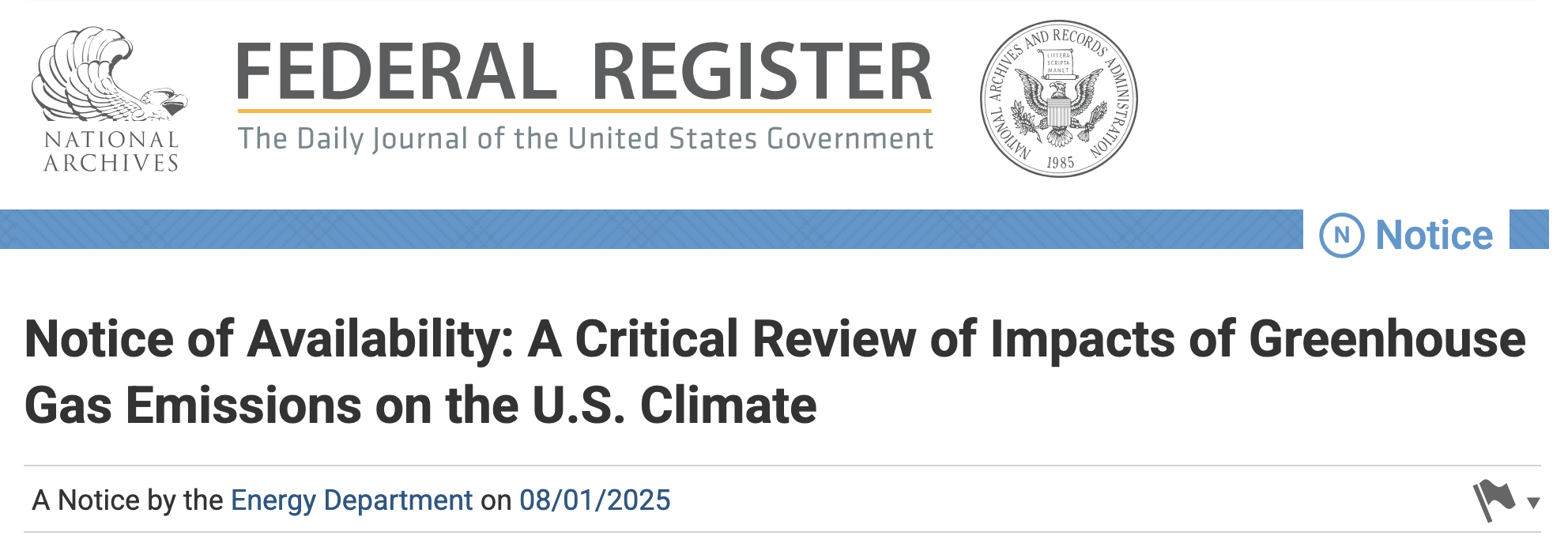
0 Comments
Leave a Reply. |
 Download the Exodus Guidebook Download the Exodus Guidebook
About
Blog focused on concrete actions we can take towards protecting life, justice and human rights.
Author
Amanda Ianthe Greene, Research, Policy and Systems Analyst, Archives
January 2026
Categories |
 RSS Feed